
Psychosocial risk has become a much more visible subject across construction.
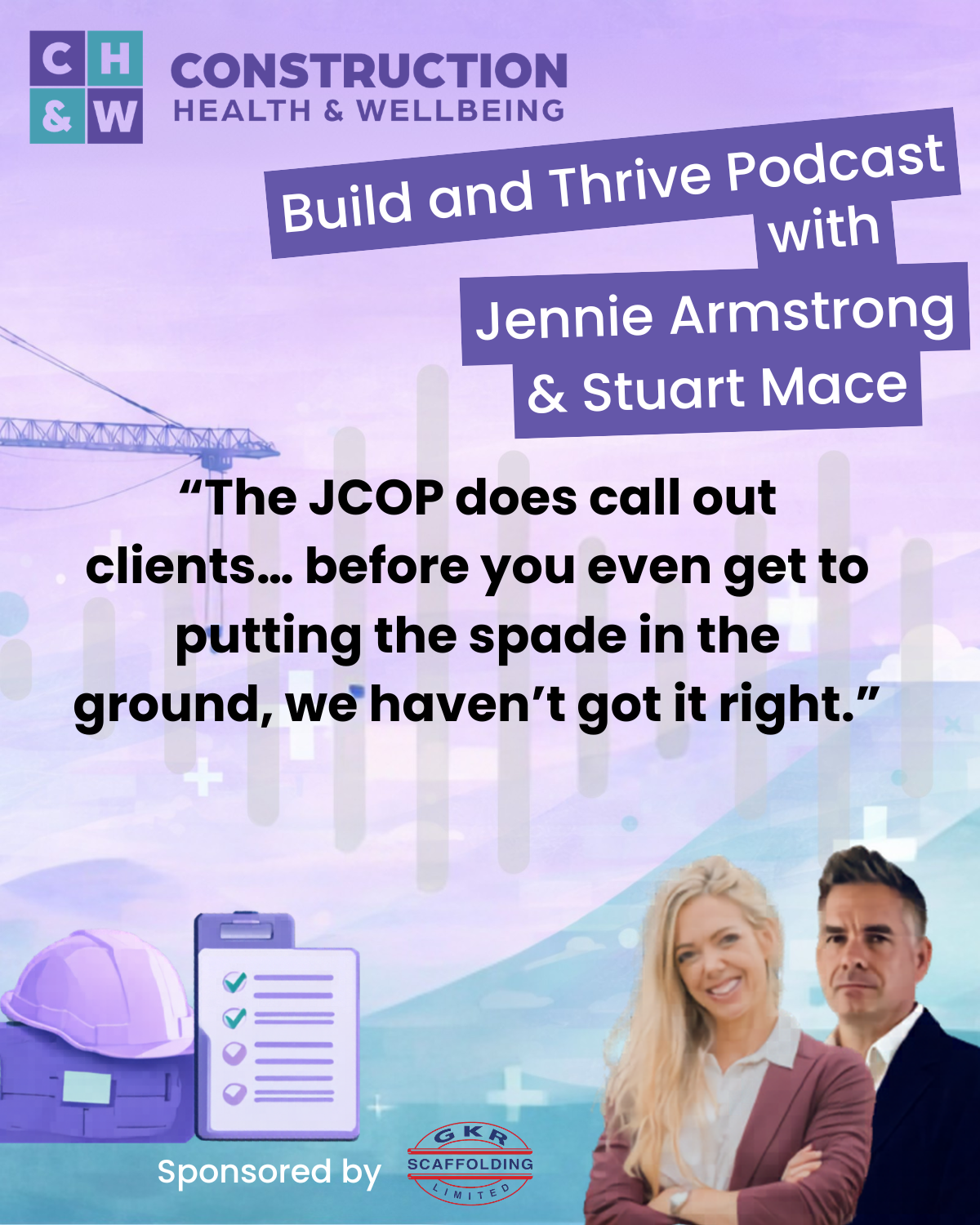
The Construction Leadership Council’s Mental Health Joint Code of Practice has added momentum to the conversation. ISO 45003 is giving organisations a recognised framework for managing psychological health and safety at work, while proposed changes to ISO 45001 are encouraging further discussion about how psychosocial risk sits within established health and safety management.
For Construction Health & Wellbeing, the most interesting change is what organisations are asking us.
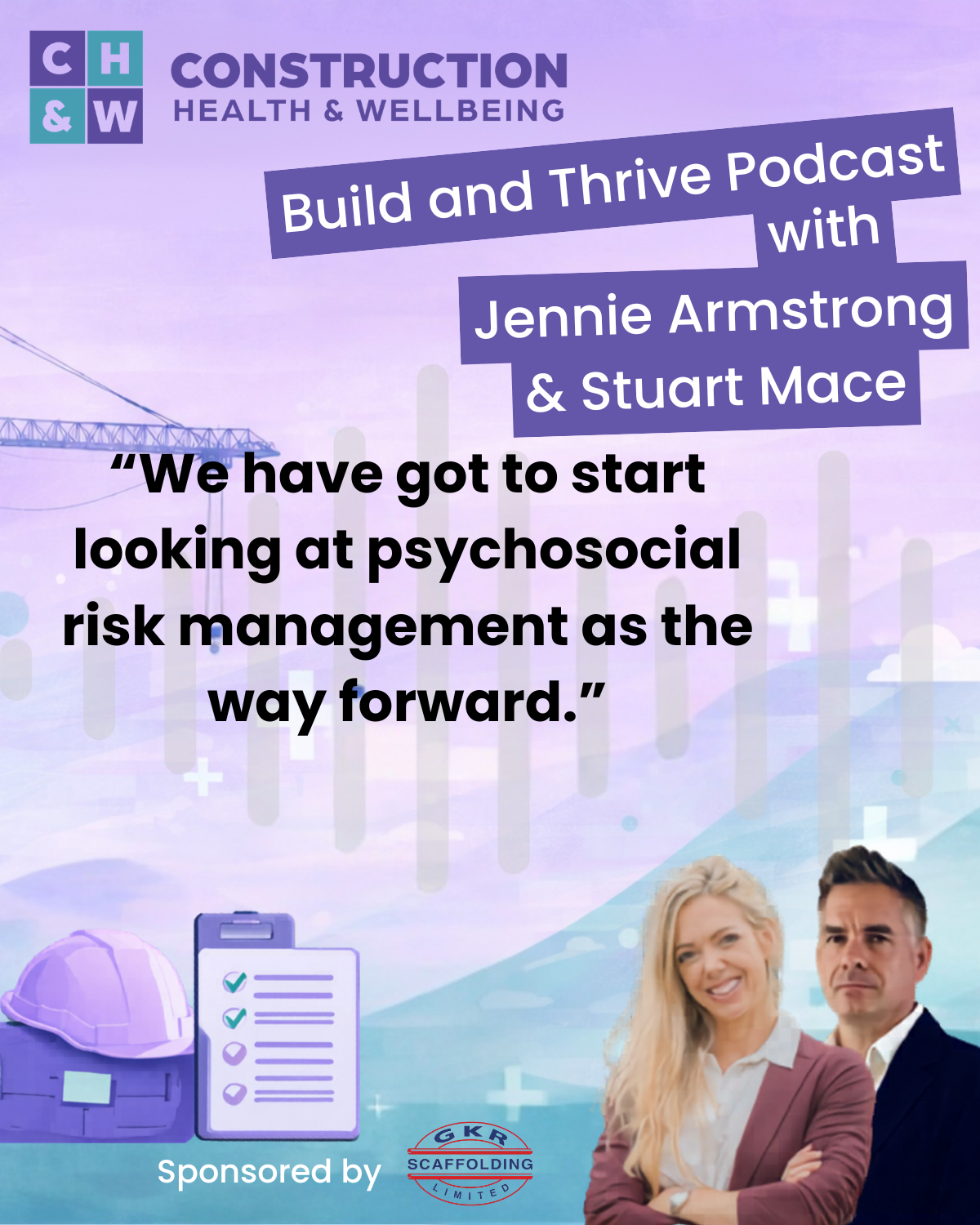
The conversation is becoming less about explaining what psychosocial risk means and much more about what organisations should actually do next.
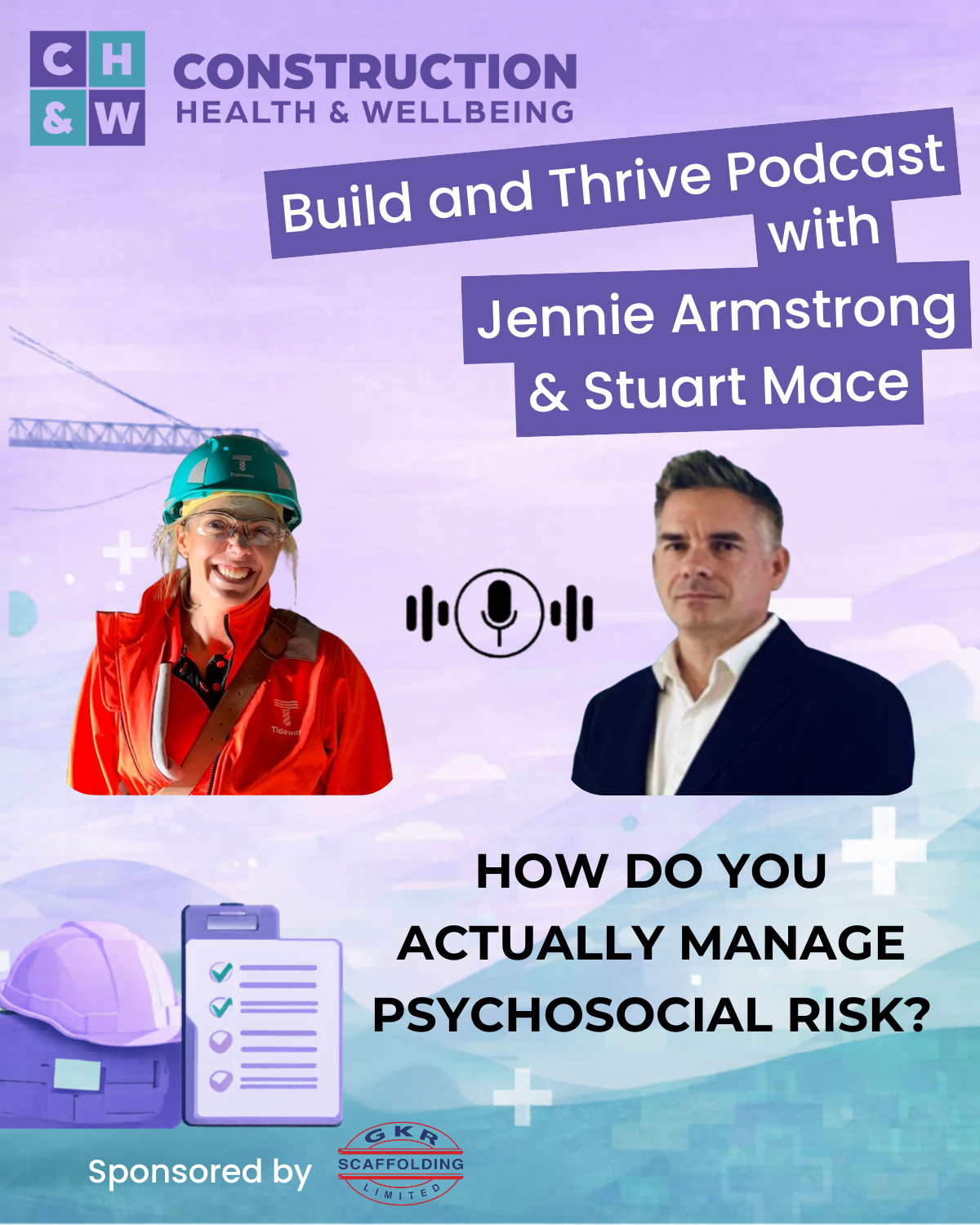
That was the focus of a recent Build & Thrive episode, where Jennie Armstrong was joined by Stuart Mace to reflect on what CH&W is seeing through current psychosocial risk gap analysis work across construction.
As Jennie puts it during the discussion: “Now is time for action. We’ve done enough of the raising the awareness.”
The episode explores some of the recurring gaps Stuart is finding inside organisations, the importance of employee voice and why effective psychosocial risk management needs to move further towards prevention.
Good intent does not always create a joined-up approach
One of the most encouraging things Stuart is seeing is genuine interest.
Organisations are inviting CH&W in to examine how they currently manage psychosocial risk, assess their systems and speak directly with people working across the business. That willingness to have an external view is an important starting point.
The problem is rarely that absolutely nothing is happening.
In many cases, quite a lot is happening.
An organisation may already undertake employee surveys. It might monitor absence, provide wellbeing initiatives and have systems for making reasonable adjustments. Health and safety teams may be carrying out related activity, while HR has other useful information.
The difficulty is that these things can remain disconnected.
Stuart describes seeing organisations with “bits and pieces going on” without a clear sense of how those activities fit together or what the organisation is ultimately trying to achieve.
That fragmentation matters because psychosocial risk rarely belongs neatly within one department.
If useful information sits in separate systems without being brought together, there is a risk that patterns are missed. The organisation can appear busy around wellbeing while still lacking a clear understanding of the hazards being created by the work itself.
Support often starts after somebody is already struggling
Another consistent theme is the timing of intervention.
Stuart regularly asks employees how their line manager would respond if they were struggling. The answer is often positive: the manager would listen, provide support or make some kind of adjustment.
That is valuable.
However, when the conversation goes deeper, the support is often triggered only after somebody has become stressed, overloaded or unwell.
This is one of the important distinctions between wellbeing support and psychosocial risk management.
A reactive approach asks what support somebody needs once the problem has appeared.
A preventative approach looks at what may have contributed to that situation in the first place.
That might involve excessive workload. Working arrangements could be creating unnecessary pressure. Behaviour within a team may be affecting people. Other aspects of the job could be making sustained stress more likely.
Stuart summarises the change simply: “We’ve got to be looking at preventing the scenarios, not reacting to them.”
That should feel familiar to anybody working in construction health and safety.
We already understand the principle of identifying hazards before somebody is harmed. Psychological health needs the same discipline.
Employee voice tells you how work is actually experienced
A major part of the CH&W gap analysis process involves speaking directly to people across an organisation.
The document review matters. Policies and management systems provide evidence of the arrangements that are supposed to be in place.
They cannot give the whole picture.
Psychosocial health is affected by the way people actually experience their work, which makes employee voice essential.
This does not require turning every workforce conversation into a technical discussion about psychosocial hazards.
As Stuart explains in the episode, he may be sitting with somebody in a cabin on site and asking much more straightforward questions.
What gets on your nerves about the job?
Is there anything that could make the work better?
Are you getting what you need to do the job properly?
That language can produce a much more useful conversation because it starts with the person’s real experience rather than expecting them to understand specialist terminology.
The distinction matters.
A policy can say that an organisation manages workload well. The people doing the work may tell you something very different.
As Stuart says: “It’s how work is experienced.”
Those experiences become another important source of evidence alongside documents, data and leadership insight. Pasted markdown
Asking people is only useful if something happens afterwards
Most organisations already collect some form of workforce feedback.
Annual staff surveys and pulse surveys are common. They can provide useful indicators of how employees are feeling.
The harder question is what the organisation does when the results identify a problem.
A survey might show that workload is causing concern. Employees may repeatedly raise the same issue. A team could report poor experiences around change or pressure.
Collecting that information is not the control.
The organisation still needs to understand the issue properly, assess the risk and decide what action is appropriate.
It then needs to check whether that action made a difference.
The episode challenges organisations to look beyond the fact that a survey has taken place and ask what changed because of what people said.
Employees notice when they are repeatedly asked for feedback and nothing appears to happen.
Over time, that can undermine confidence in the process itself.
Employee voice therefore needs to be connected to action. Listening should help an organisation understand the hazards within the work and give people a meaningful opportunity to contribute to better ways of managing them.
The fear of opening a can of worms
One of the more candid parts of the conversation concerns stress risk assessment.
Stuart describes the resistance that can sometimes appear when an organisation is encouraged to examine work-related stress more closely.
There can be an understandable nervousness that asking employees about these issues will uncover problems that then need addressing.
The phrase “can of worms” comes up.
The problem with that logic is that the assessment did not create the risk.
If workload or another aspect of work is already causing harm, avoiding the conversation simply means the organisation has less visibility of it.
Recognising a psychosocial hazard also does not mean that every source of pressure must disappear.
Construction can be demanding. Projects have deadlines. Difficult periods will happen.
Good psychosocial risk management is about understanding where those demands may become harmful and considering what proportionate action can reduce the risk.
That makes it much closer to familiar health and safety practice than some organisations may initially assume.
Managing risk does not mean creating a pressure-free workplace
This point is worth emphasising because it can remove some of the fear around psychosocial risk management.
The objective is not to eliminate every demanding part of somebody’s job.
There will be circumstances where a hazard cannot be completely removed. The task then becomes reducing the exposure or putting better controls around it.
During the podcast, Stuart discusses using the hierarchy of controls as a useful way of thinking about psychological health risks.
That might mean examining how the work is organised or changing an aspect of the task. It might involve introducing a different intervention. Often, the people experiencing the hazard will have useful ideas about what could genuinely improve the situation.
The solution may need adjusting after it has been introduced.
That is normal risk management.
The important thing is that the organisation has identified the issue and is actively trying to manage it, rather than waiting for somebody to become unwell before responding.
Leadership has a significant role
This work cannot sit exclusively within health and safety.
It cannot be left entirely to HR or a wellbeing team either.
Psychosocial hazards can be shaped by decisions made across an organisation, which means leadership needs to understand its own influence.
Stuart deliberately includes senior leaders in the gap analysis process because leadership behaviour and organisational decisions can affect the conditions people experience lower down.
Some of the leaders he meets already understand this. Their question is often practical: tell me what I need to do.
Others require more challenges.
That is one reason psychosocial risk management needs to become an organisational conversation rather than another specialist activity sitting at the edge of the business.
What does this mean for construction businesses now?
The direction discussed throughout the episode is clear.
Psychosocial risk is becoming harder to separate from normal occupational health and safety management.
Stuart also reflects on the potential role of the CLC Joint Code of Practice across the construction supply chain and the significance that proposed revisions to ISO 45001 could have for larger contractors.
His expectation is that organisations will increasingly need to demonstrate what they are doing, rather than simply having a policy that says psychological health matters.
The practical starting point does not need to be complicated.
Construction businesses can begin by asking how work is being experienced.
Look at what employees are already telling you. Identify the pressures that keep appearing. Decide which of those could cause harm and assess them properly.
Most importantly, do something with what you find.
Key takeaways
- Good intent needs structure. Existing activity is much more useful when it is connected to a clear understanding of risk.
- Support is not the same as prevention. Helping somebody once they are struggling matters, but organisations should also examine what contributed to the problem.
- Employee voice is essential. Documents describe intended practice. The workforce can tell you how the job is really being experienced.
- Feedback needs to lead to action. Surveys and conversations have limited value if recurring issues are never assessed or addressed.
- Risk does not need to be eliminated completely to be managed. The aim is proportionate control and continual improvement.
- Leadership needs to be involved. Psychosocial risk is influenced by the way work is organised and the decisions made across the business.
Listen or watch the full episode of Build & Thrive to hear the complete conversation with co-host Stuart Mace and host Jennie Armstrong.
🎧 https://www.buzzsprout.com/2431164
📺 https://www.youtube.com/playlist?list=PLEoibJLDuFnnT3qSQw37LKPG6xlyvCj7B
Join the Conversation!
Do you have experiences or thoughts on addiction and recovery in construction?
Drop a comment below or share this post to help break the stigma. Together, we can make wellbeing part of the culture – not just the policy.
Thank you to GKR Scaffolding for sponsoring the Build & Thrive podcast and supporting our mission to improve health and wellbeing across the construction industry.
At Construction Health & Wellbeing, we help organisations create healthier, happier, and more sustainable workplaces.
Contact us today to learn how we can support your strategy.
Learn more about the people and organisations mentioned in this episode:
Jennie Armstrong: https://www.linkedin.com/in/jenniearmstrong/
Stuart Mace: https://www.linkedin.com/in/stuartmace/
Construction Health & Wellbeing: https://constructionhealth.co.uk/
GKR Scaffolding (sponsor): https://gkrscaffolding.co.uk/
